
BSG Business Resource 001
Is your technology fit for your business?
The BSG VITAL Technology Health Check
This practical health check guides you through the five interconnected areas of the BSG VITAL Technology Framework, helping you recognise strengths, identify areas of uncertainty and decide what deserves attention next.
Business Resource 001
Approx. 12 min read
For business leaders
Last reviewed July 2026
What you'll gain
See what’s working, uncover what isn’t – and prioritise what to do next
Technology can appear to be working while still creating friction, uncertainty or avoidable risk. Recurring problems can become accepted as normal, responsibilities may be assumed rather than confirmed, and systems may remain in place long after the organisation has outgrown them.
The BSG VITAL Technology Health Check helps you step back from individual devices and day-to-day issues to consider the bigger picture, identify what most deserves your attention and prioritise the next steps that will make the greatest difference.
Assess the five VITAL areas
Consider your organisation across the five interconnected areas that shape technology fitness.
Recognise strengths and uncertainty
See where your foundations appear strong and where important questions remain.
Uncover hidden friction
Identify recurring frustrations, unclear responsibilities and hidden dependencies.
Focus on three priorities
Choose the three areas that matter most – not an overwhelming list of possible improvements.
Ask better questions
Have more useful conversations with your leadership team, IT team or technology provider.
Identify a sensible starting point
Decide what deserves attention next – without assuming every issue requires a new solution.
A practical business health check. This is a business-level health check – not a technical audit, security certification or guarantee of compliance. Its purpose is to help you recognise where confidence is justified, where greater clarity may be valuable and what deserves further attention.
A better question
Working technology is only the baseline
Technology is often judged by a seemingly straightforward question: is it working?
It is an understandable place to start – but it only tells us whether technology appears to be functioning at this moment. It does not tell us whether it is reliable, secure, resilient or still suited to what the organisation requires.
Technology influences much more than whether employees can switch on a device or access a system. It shapes how productively people work, how reliably customers are served, how information and access are protected, how the organisation responds to disruption and how confidently leaders can plan and invest.
The goal is not to have the newest, most complex or most expensive technology. It is to have technology that is appropriate for the organisation it serves.
THE USUAL QUESTION:
Is our IT working?
A useful operational question – but only a snapshot of whether technology is functioning right now.
THE LEADERSHIP QUESTION:
Is our technology appropriate for what the organisation depends upon, what it needs today and where it is going?
A broader question that considers fitness, risk, resilience and future direction.
A moment to consider
Where does technology currently make your organisation easier to run – and where does it make work harder than it needs to be?
The BSG VITAL Technology Framework
The BSG VITAL Technology Framework:
Five interconnected areas of technology fitness
Technology is not simply a collection of devices, systems, licences and support tickets. It is an operational business asset – and its value depends on whether it is understood, reliable, protected, recoverable and aligned with what the organisation needs.
The BSG VITAL Technology Framework brings these considerations together into five interconnected areas, helping business leaders take a broader and more structured view of technology fitness.
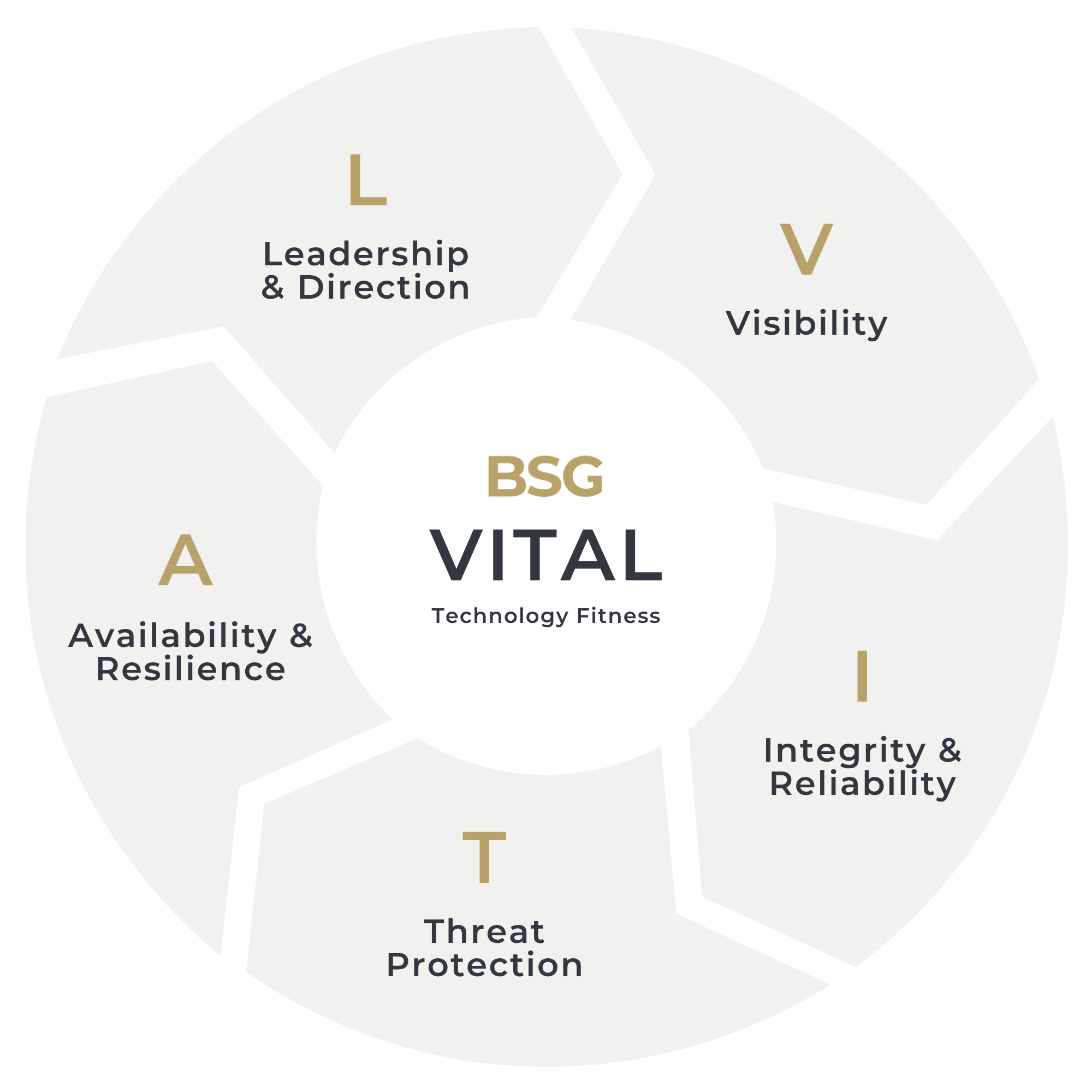

Visibility
Do we understand what the business depends upon?
A clear view of the systems, information, suppliers, responsibilities and dependencies that support the business.

Integrity & Reliability
Does technology operate consistently and support productive work?
Reliable technology performs as intended, while recurring problems and avoidable friction are properly addressed.

Threat Protection
Are our systems, information and people appropriately protected?
Practical safeguards, informed behaviours and clear responsibilities help reduce the likelihood and impact of security incidents.

Availability & Resilience
Could the business continue and recover following disruption?
Effective resilience considers what happens when something important becomes unavailable – and whether recovery arrangements work in practice.

Leadership & Direction
Is technology guided by clear business priorities and future needs?
Technology decisions should reflect business plans, expected change, investment priorities and the outcomes the business is trying to achieve.
Why the five areas form a cycle
The five areas are connected rather than independent. Limited visibility makes it harder to improve reliability, protect what matters, prepare for disruption or make well-informed plans.
Technology decisions and business changes can introduce new systems, suppliers, working practices, dependencies and risks. These changes must then become visible and understood, returning the organisation to the beginning of the cycle.
Technology fitness is not a one-off achievement or a perfect score. It is a continuing management cycle: understand, support, protect, prepare, align – and review again as the organisation changes.
Your BSG VITAL Technology Health Check
Build a clearer picture of your business' technology health
Consider each statement from the perspective of the organisation as a whole. You do not need detailed technical knowledge to complete the health check. What matters is whether your organisation can answer confidently, identify who is responsible and explain how it knows.
For each statement, choose the response that most accurately reflects your organisation’s current position:
Confident
We know this is appropriately addressed and could explain or evidence it.
Some uncertainty
Something is in place, but we are not fully certain how effective, current or complete it is.
Needs attention
This is absent, unsuitable or already known to be causing concern within the business.
Not known
We do not currently have enough visibility or verified information to answer confidently.
“Not known” is not a neutral answer. It may reveal that the business is relying on an assumption rather than verified information.
You do not need to calculate a total score. Instead, keep a simple note of any statements that create uncertainty, reveal a weakness or prompt an important question. You will use these observations later to build your VITAL Summary and identify three priorities.
As you work through the health check, keep a note of anything you cannot confidently answer.
V · I · T · A · L
V – Visibility
Can your business clearly see and understand the technology, information, suppliers and dependencies it relies on?
Why visibility matters
Important technology decisions become difficult when business leaders cannot see the whole picture. Gaps in documentation, unclear responsibilities or dependence on knowledge held by one person can remain unnoticed while everything appears to be running normally.
Clear visibility helps the business understand what it relies on, who is responsible and where greater certainty may be needed.
Assess your current position
For each statement below, choose the response that most accurately reflects your business today. Keep a note of any statement you cannot answer confidently.
Response options: Confident · Some uncertainty · Needs attention · Not known
01
Business leaders have a clear, non-technical view of the important systems, services, suppliers and dependencies the business relies on.
02
Responsibility for technology decisions, security, user access and supplier management is clear and understood.
03
Important systems, devices, accounts, licences, contracts and renewal dates are documented and kept current.
04
Important knowledge is documented and accessible, rather than being held only by one employee or supplier.
05
Business leaders can obtain clear, current information about technology risks, performance, costs and priorities.
06
Changes to systems, suppliers or working practices are recorded and reflected in the business’s technology information.
What did you notice?
Which statements were difficult to answer confidently?
Consider whether your answers relied on assumptions, knowledge held by another person or information you could not readily access. Make a note of anything you may need to clarify or investigate.
V · I · T · A · L
I – Integrity & Reliability
Can your business rely on its technology and information to remain accurate, properly maintained and fit for purpose?
Why integrity and reliability matter
Technology does not need to stop working completely to affect a business. Recurring faults, inconsistent performance, ageing equipment or poorly controlled changes can gradually reduce productivity and confidence while becoming accepted as part of everyday work.
Reliable technology is appropriately maintained, supported and reviewed. Its information and configurations remain accurate, and recurring problems are addressed at their cause rather than repeatedly worked around.
Assess your current position
For each statement below, choose the response that most accurately reflects your business today. Keep a note of any statement you cannot answer confidently.
Response options: Confident · Some uncertainty · Needs attention · Not known
01
Important systems and devices perform consistently, without recurring faults, unexplained disruption or persistent workarounds.
02
Technology is routinely maintained, updated and reviewed rather than receiving attention only when something goes wrong.
03
Ageing, unsupported or unsuitable technology is identified early and addressed through a planned replacement or improvement process.
04
Changes to systems, configurations and user access are properly authorised, tested where appropriate and documented.
05
Important business information is accurate, consistent and protected against unintended alteration, duplication or loss of quality.
06
Recurring technology issues are investigated at their underlying cause, with lessons and improvements carried forward.
What did you notice?
Where has your business become accustomed to unreliable technology, recurring problems or temporary workarounds?
Consider whether any issue is being repeatedly managed rather than properly resolved, or whether important maintenance and replacement decisions are being postponed. Make a note of anything that may require closer review.
V · I · T · A · L
T – Threat Protection
Are your systems, information and people appropriately protected against the threats most relevant to your business?
Why threat protection matters
Effective protection does not come from one product, policy or annual exercise. It depends on appropriate layers of security, clear responsibilities, reliable processes and people who know how to respond when something does not look right.
Threats, technologies and business obligations continually change. Protection therefore needs to be actively maintained and reviewed – not simply introduced once and assumed to be working.
Assess your current position
For each statement below, choose the response that most accurately reflects your business today. Keep a note of any statement you cannot answer confidently.
Response options: Confident · Some uncertainty · Needs attention · Not known
01
Important accounts and systems use appropriate access controls and multifactor authentication wherever it is needed.
02
Access is reviewed and updated promptly when people join the business, change responsibilities or leave.
03
Devices, software and security protections are maintained, monitored and kept current across the business.
04
Employees receive practical guidance and know how to recognise and report suspicious activity or potential security incidents.
05
Security alerts, vulnerabilities and suspected incidents have clear ownership and are investigated and addressed appropriately.
06
Leadership understands the business’s most relevant cyber and information risks, and reviews whether its protections remain appropriate as circumstances change.
What did you notice?
Which protection measures are you relying upon without being certain they are configured, monitored or used effectively?
Consider whether any important safeguard is assumed to be working, depends heavily on one person or has not been reviewed as the business and its risks have changed. Make a note of anything that may require verification or closer attention.
V · I · T · A · L
A – Availability & Resilience
Could your business continue operating and recover effectively if important technology or information became unavailable?
Why availability and resilience matter
Backups, cloud services and support arrangements can provide reassurance – but resilience depends on understanding what is and is not protected, what can actually be recovered, how long recovery will take and whether people know what to do when normal systems are unavailable.
Disruption may result from a cyber incident, technology failure, human error, supplier outage or physical event. A resilient business understands what is most critical, prepares practical alternatives and tests whether its recovery arrangements will work when needed.
Assess your current position
For each statement below, choose the response that most accurately reflects your business today. Keep a note of any statement you cannot answer confidently.
Response options: Confident · Some uncertainty · Needs attention · Not known
01
The systems, information and services most critical to the business have been identified and prioritised.
02
The business understands which important data and systems are included within its backup arrangements, which are not, and whether appropriate protection is in place across on-premises, hosted and cloud-based services.
03
Backup failures are monitored and addressed, and important data and systems have been successfully restored through testing.
04
Responsibilities, communication routes and first actions are clear if systems become unavailable or a cyber incident occurs.
05
The business understands how long its important services could be unavailable and how much information it could lose before the impact becomes unacceptable.
06
Dependencies on key suppliers and technology have been considered, with practical alternatives or continuity arrangements in place where appropriate.
What did you notice?
If an important system became unavailable tomorrow morning, what might your business discover too late?
Consider whether there are gaps in what is backed up, recovery arrangements that have not been tested, knowledge held by one person or support arrangements whose scope and response expectations are not clearly understood. Make a note of anything that could delay recovery or leave people unsure what to do.
V · I · T · A · L
L – Leadership & Direction
Is technology being guided by clear business priorities, informed leadership and a realistic view of future needs?
Why leadership and direction matter
Technology decisions create greater value when they begin with what the business is trying to achieve. Without clear direction, replacements become urgent, costs arrive unexpectedly and systems can constrain change rather than support it.
Effective leadership does not require detailed technical knowledge. It requires clear priorities, proportionate planning and advice that helps decision-makers understand the risks, costs, practical implications and business value of their choices.
Assess your current position
For each statement below, choose the response that most accurately reflects your business today. Keep a note of any statement you cannot answer confidently.
Response options: Confident · Some uncertainty · Needs attention · Not known
01
Business plans, operational priorities and anticipated changes actively inform technology decisions.
02
Known equipment, software, licensing and infrastructure needs are anticipated, prioritised and budgeted for wherever reasonably possible.
03
Technology proposals are evaluated against the outcomes they should support, rather than features or immediate cost alone.
04
The business has a small number of clear, proportionate technology priorities, with ownership and appropriate next steps understood.
05
Leadership receives advice that considers risk, usability, cost, timing and the business’s capacity to implement and manage change.
06
Existing systems, tools and licences are reviewed to ensure they remain suitable and are being used effectively before further technology is purchased.
What did you notice?
What planned change or business priority could your current technology struggle to support?
Consider whether upcoming growth, new ways of working, regulatory obligations, service changes or ageing technology may create needs that have not yet been fully anticipated. Make a note of any decision that would benefit from earlier planning or clearer advice.
Continue the cycle
Return to Visibility
Leadership and direction are not the end of the BSG VITAL framework. Every decision can introduce new systems, suppliers, responsibilities and dependencies.
As plans become action, return to Visibility: understand what has changed, confirm whether it is working as intended and identify what now deserves attention. In this way, BSG’s VITAL framework becomes an ongoing cycle of understanding, strengthening and improving the technology your business depends upon.
Understand your findings
Create your five-area VITAL summary
Your VITAL summary brings together what you found across the five areas. It helps you see where the business appears to have a stronger foundation, where important uncertainty remains and where closer attention may be needed.
Review your responses in each VITAL area and decide which of the three positions below describes it most accurately. Choose one overall position for each area and note the most important finding that influenced your decision.
Choose one position for each VITAL area
Use the guidance below to decide which position best reflects your findings in each area. You may use the same position more than once. Consider the significance of what you identified – not simply the number of confident or uncertain answers.
Stronger foundation
Choose this where answers are generally confident and supported by current information, appropriate evidence or clear ownership – and you have not identified a concern that could materially affect the business.
Note what is working well and should be maintained or reviewed periodically.
Some uncertainty
Choose this where important answers rely on assumptions, incomplete information or arrangements that have not recently been confirmed.
This does not necessarily mean something is wrong. Note what should be checked, clarified or supported by better evidence.
Greater attention recommended
Choose this where you identified an issue that could materially affect security, reliability, recovery or the business’s ability to operate and develop.
One significant concern may justify this position even where several other answers were confident.
Record your five-area summary
Assign one overall position to each VITAL area. Alongside it, note the most important strength, uncertainty or concern that influenced your decision.
You can write your summary in your notes, print this page or use the structure below as the basis for a leadership or provider discussion.
BSG VITAL area
Your overall position
Most important finding
V – Visibility
Stronger foundation / Some uncertainty / Greater attention recommended
What most influenced your decision?
I – Integrity & Reliability
Stronger foundation / Some uncertainty / Greater attention recommended
What most influenced your decision?
T – Threat Protection
Stronger foundation / Some uncertainty / Greater attention recommended
What most influenced your decision?
A – Availability & Resilience
Stronger foundation / Some uncertainty / Greater attention recommended
What most influenced your decision?
L – Leadership & Direction
Stronger foundation / Some uncertainty / Greater attention recommended
What most influenced your decision?
V – Visibility
Your overall position
Stronger foundation / Some uncertainty / Greater attention recommended
Most important finding
What most influenced your decision?
I – Integrity & Reliability
Your overall position
Stronger foundation / Some uncertainty / Greater attention recommended
Most important finding
What most influenced your decision?
T – Threat Protection
Your overall position
Stronger foundation / Some uncertainty / Greater attention recommended
Most important finding
What most influenced your decision?
A – Availability & Resilience
Your overall position
Stronger foundation / Some uncertainty / Greater attention recommended
Most important finding
What most influenced your decision?
L – Leadership & Direction
Your overall position
Stronger foundation / Some uncertainty / Greater attention recommended
Most important finding
What most influenced your decision?
What does your five-area VITAL summary reveal?
Once you have considered each VITAL area, look across the complete summary. This helps you recognise the strengths, uncertainties and connected issues that matter most to the business – not only what appeared within each area individually.
Use the questions below to review the complete picture. As you do, note any strengths, unknowns or concerns that you want to carry forward.
Look across all five areas and consider:
01
Where do we appear to have the strongest foundations?
Identify what is working well, what gives you confidence and what should be maintained.
02
Where is uncertainty concentrated?
Notice where answers rely on assumptions, incomplete information or arrangements that have not recently been confirmed.
03
Are our confident answers supported by evidence?
Consider whether confidence comes from current documentation, testing, clear ownership or reliable information – or simply from believing that something is probably covered.
04
Does one issue affect several VITAL areas?
A recurring problem, unclear responsibility, ageing system or important dependency may influence reliability, security, resilience and future planning at the same time.
05
Is there one concern whose potential impact makes it especially important?
A significant recovery gap, security weakness or critical dependency may deserve attention even if the rest of that VITAL area appears relatively strong.
Consider significance as well as the overall position. The three positions provide a simple way to summarise what you found, but they do not determine what should take priority. One significant unknown, unsupported assumption or business-critical dependency may require more attention than several smaller weaknesses.
Capture what you want to carry forward
Use the questions above to identify the findings that matter across your complete VITAL summary. Record a short note under each of the following in your own notes.
01
Strengths to maintain
What is working well and should continue to be protected, reviewed or developed?
02
Unknowns to verify
What needs to be checked, clarified or supported by better evidence?
03
Findings to explore further
What concern, recurring problem or connected issue may deserve closer attention?
Keep these notes with your five-area summary. The next section will help you look beneath visible symptoms and understand what may be contributing to them before you decide what should take priority.
Look a little deeper
The visible problem may not be the underlying issue
Technology problems are often experienced as isolated frustrations: a slow device, an interrupted process, an unexpected cost or an issue that keeps returning.
The immediate problem matters, but addressing the symptom alone may provide only temporary relief. Looking beneath it can reveal unclear ownership, inconsistent systems, ageing infrastructure, gaps in planning or dependencies the business had not fully recognised.
Before deciding what to buy or change, ask what may be allowing the problem to continue.
How a visible problem can point to a wider weakness
The examples below show how a familiar technology concern can lead to more useful questions. They are not a checklist and you do not need to record an answer to each one. Use them to help you examine the findings you carried forward from your VITAL summary.
What the business notices
What may be worth exploring
The same issues keep returning
Whether the underlying cause has been identified; whether configuration, ageing equipment or inconsistent standards are contributing; and whether permanent corrective work is being displaced by repeated short-term fixes.
Employees have developed workarounds
Why the normal process is not meeting their needs; whether the workaround introduces security, information or operational risks; and whether unofficial tools or duplicated processes have become embedded in everyday work.
Support feels reactive or unclear
Whether responsibilities, escalation routes, priorities and response expectations are understood; whether recurring issues are being reviewed; and whether the support model still reflects the needs of the business.
The business is reassured that its information is “in the cloud”
Which information and services are actually protected; what recovery options exist; how long information is retained; and whether important cloud, hosted and on-premises data are covered by the arrangements the business expects.
Technology costs feel unpredictable
Whether equipment lifecycles, renewals, licensing changes and known infrastructure needs are visible and planned – or whether necessary investment repeatedly arrives as an urgent surprise.
One person in the business seems to know how everything works
Whether important knowledge, access or decision-making is concentrated in one person; whether documentation is sufficient; and what would happen if that person became unavailable or left the business.
What the business notces
The same issues keep returning
What may be worth exploring
Whether the underlying cause has been identified; whether configuration, ageing equipment or inconsistent standards are contributing; and whether permanent corrective work is being displaced by repeated short-term fixes.
What the business notces
Employees have developed workarounds
What may be worth exploring
Why the normal process is not meeting their needs; whether the workaround introduces security, information or operational risks; and whether unofficial tools or duplicated processes have become embedded in everyday work.
What the business notces
Support feels reactive or unclear
What may be worth exploring
Whether responsibilities, escalation routes, priorities and response expectations are understood; whether recurring issues are being reviewed; and whether the support model still reflects the needs of the business.
What the business notces
The business is reassured that its information is “in the cloud”
What may be worth exploring
Which information and services are actually protected; what recovery options exist; how long information is retained; and whether important cloud, hosted and on-premises data are covered by the arrangements the business expects.
What the business notces
Technology costs feel unpredictable
What may be worth exploring
Whether equipment lifecycles, renewals, licensing changes and known infrastructure needs are visible and planned – or whether necessary investment repeatedly arrives as an urgent surprise.
What the business notces
One person in the business seems to know how everything works
What may be worth exploring
Whether important knowledge, access or decision-making is concentrated in one person; whether documentation is sufficient; and what would happen if that person became unavailable or left the business.
Apply the thinking
Which of your findings deserves a deeper question?
Return to the unknowns and findings you carried forward from your five-area VITAL summary. Consider whether any of them are recurring, connected to another issue or currently being managed through a workaround rather than resolved.
You do not need to diagnose the technical cause yourself. The purpose is to describe what the business is experiencing and identify the deeper question that should be investigated before a solution is chosen.
01 — The visible problem
What is the business currently experiencing?
Describe what is happening in practical terms – for example, what keeps going wrong, who or what is affected and whether the issue is recurring.
02 — The deeper question
What condition, decision or dependency may be allowing it to continue?
Use this to identify what needs to be investigated. You may be questioning ownership, configuration, consistency, capacity, lifecycle planning, documentation or an assumption that has not been verified.
Example
Visible problem
Employees regularly use personal file-sharing tools because sending large files through the normal process is difficult.
Deeper question
Why is the approved process not meeting their needs, and do the workarounds create security, access or information-management risks?
Record these alongside the findings you carried forward from your VITAL summary. In the next section, you will use what you have identified to decide where attention may be most valuable.
Your three priorities
Chose what matters most
You may now have several strengths, unknowns, concerns and deeper questions in your notes. They will not all carry the same significance – and they do not all need to be addressed at once.
The purpose of this step is to identify up to three matters that deserve attention first, based on their importance to the organisation and the value of gaining greater clarity or making an improvement.
A priority does not have to be the largest or most technical issue. It may be the uncertainty, dependency or recurring problem that creates the greatest business exposure – or the practical improvement that would make a meaningful difference.
What should influence your decision?
Review the findings and deeper questions you have recorded. A matter may deserve priority if one or more of the following applies.
Business interruption
It could significantly disrupt an important service, process or part of the organisation.
Time and operational friction
It repeatedly wastes employee time, delays work or makes an important, regular business process harder than it should be.
Unverified reliance
The business depends on an arrangement, control, supplier or assumption that has not been clearly confirmed.
Financial, regulatory or reputational exposure
It could create a meaningful financial loss, compliance concern or loss of trust.
Increasing difficulty
It is likely to become more difficult, costly or disruptive as the organisation grows, changes or continues to rely on ageing technology.
Worthwhile improvement
A proportionate change or clarification could deliver a meaningful improvement without requiring a major project.
You do not need to formally score every finding. Use these considerations to compare what you have identified and decide where attention would be most valuable.
Make the choice
Select up to three priorities
Choose the matters that appear most important to understand, verify or improve. If only one or two genuinely stand out, you do not need to invent a third.
01
What have we identified?
Describe the concern, unknown, dependency or opportunity clearly and briefly.
02
Why does it matter?
Note the potential effect on the organisation, its people, its customers or its ability to operate.
03
What needs to be clarified or changed?
Identify the question that needs answering or the outcome that would improve the current position.
04
Who should be involved?
Consider who holds the relevant knowledge, responsibility or authority – internally or through an existing technology provider or specialist.
05
What is the first practical step?
Choose one realistic action that will move the matter forward without trying to solve everything immediately.
Record these details for each of your selected priorities in your own notes or in the accompanying workbook.
What kind of action is needed?
The right next step will depend on what you already know. For each priority, choose the type of action that best reflects the current position.
Clarify
Obtain the info needed to understand the current position, responsibility or arrangement.
Confirm
Verify that an assumed control, service or process exists and works as expected.
Improve
Address a known weakness, recurring problem or source of unnecessary friction.
Plan
Prepare for a future replacement, investment, business change or emerging need.
Not every uncertainty requires an immediate project. Sometimes the most valuable first step is simply to obtain clear information, confirm an assumption or establish who is responsible.
Once you have selected your priorities and identified the type of action needed, the next step is to ask the questions that will help you move each one forward.
Start better conversations
Questions worth asking
Once you have identified what matters most, the next step is not necessarily to choose a solution. It is to ask the questions that will help you understand the current position, test important assumptions and establish what should happen next.
Use the questions below with your leadership team, internal IT team, existing technology provider or relevant specialist. Select the questions that relate to your priorities – you do not need to ask or answer every one.
A useful answer should leave you clearer about the current position, the evidence supporting it, who is responsible and whether any further action is needed.
V – Visibility
Understand what the organisation depends on
- Which systems and services would affect the organisation most if they became unavailable?
- Where are we dependent on one person, supplier or undocumented process?
- Which important technology risk or dependency are we currently least certain about?
I – Integrity & Reliability
Explore recurring problems and operational friction
- Which technology issues consume the most employee time or repeatedly interrupt work?
- Which recurring problems are being managed through temporary fixes rather than permanently resolved?
- How do we identify when equipment, systems or processes are no longer reliable or appropriate for the organisation?
T – Threat Protection
Clarify protection, oversight and responsibility
- Who reviews security alerts, decides what requires action and confirms that action has been completed?
- Could we remove or change someone’s access quickly and completely when their role changes or they leave?
- What evidence shows that our security protections remain current, correctly configured and effective?
A – Availability & Resilience
Test recovery assumptions and preparedness
- When were our backups last successfully restored as a test, and what did that test cover?
- What would we do first if a critical system or service became unavailable tomorrow?
- How long could the organisation operate without each important system, and does our recovery capability reflect that?
L – Leadership & Direction
Connect technology decisions with business plans
- What technology decisions, replacements or costs should we expect during the next 12–24 months?
- How are technology priorities connected to the organisation’s wider plans, risks and operational needs?
- Which existing tools, licences or services are we paying for but not using effectively?
Use what you learn
Ask for clarity, evidence and ownership
For each of your selected priorities, choose the questions that will help you move it forward. You may use the questions above exactly as written, adapt them to your organisation or add a more specific question of your own.
As you discuss each priority, capture:
01
The answer
What have you learned about the current position?
02
The evidence
What information, documentation, testing or reporting supports the answer?
03
The owner
Who is responsible for clarifying, confirming, improving or planning what happens next?
04
The follow-up
Is any further information, decision or practical action required?
Record only the information that materially changes your understanding or creates a clear follow-up action. You do not need to produce detailed notes from every conversation.
One final question
If you were responsible for this business, what would you address first – and why?
This question can reveal priorities, concerns or dependencies that a standard report may not make obvious. The quality of the explanation matters more than whether the answer sounds reassuring.
Look for an answer that is clear, proportionate, supported by evidence and connected to business impact. If the recommendation is unclear, ask what has influenced it and what practical first step would be appropriate.
These conversations should give you a clearer view of what is known, what still needs to be verified and where responsibility sits. The next section explains how we would approach those findings if this were our business.
The BSG perspective
If this were our business, we would begin by reducing uncertainty
We would not begin by assuming that more technology, a major project or immediate investment was the answer.
Before recommending what should change, we would first seek a clear understanding of what the organisation depends on, where the greatest business impact could arise and which important assumptions have, or have not, been verified.
Only then would we decide what deserves attention, in what order and at what level of investment.
First, we would ask
What matters most to the business?
We would want to understand:
01
What does the organisation depend on most?
The systems, services, information, suppliers and people that are most important to its ability to operate.
02
Where would disruption or loss have the greatest impact?
Not only technically, but financially, operationally, reputationally or through the effect on customers and employees.
03
Which current problems create the most friction?
The recurring issues, delays and workarounds that consume time or make important work harder.
04
Which important assumptions have not been verified?
The protections, recovery arrangements, responsibilities or dependencies that may be relied upon without clear evidence.
05
What is likely to change next?
The organisation’s plans, growth, people, locations, services and regulatory or operational requirements.
These questions establish the business context needed to distinguish genuine priorities from technical noise.
Our starting principles
Make decisions in proportion to the need
Begin with visibility
Reduce important unknowns before prescribing solutions.
Consider business significance
Judge a finding by its effect on the organisation – not technical severity alone.
Focus on meaningful priorities
Concentrate attention on a small number of matters that genuinely deserve it.
Address underlying causes
Resolve the source of recurring problems wherever practical, rather than repeatedly managing the symptoms.
Use what is already in place effectively
Improve existing systems, services and processes before introducing unnecessary complexity.
Match the response to the organisation
Make proportionate decisions based on its actual needs, risks, resources and plans.
Give leaders usable clarity
Provide enough evidence, explanation and visibility for informed decisions – not simply more technical information.
Keep the picture current
Visibility is not a one-time exercise
Once priorities have been clarified and acted upon, we would review what has changed and whether the intended outcome has been achieved.
New systems, suppliers, working practices and business plans create new dependencies and questions. Returning to Visibility keeps the VITAL cycle active – so technology decisions remain connected to the organisation as it evolves.
The aim is not to eliminate every uncertainty. It is to ensure that the uncertainties which matter are visible, understood and managed deliberately.
What happens next?
Has your VITAL Health Check raised questions you cannot yet answer confidently?
Start by sharing your findings and priorities with the appropriate people – whether that is your leadership team, internal IT team, current technology provider or another relevant specialist.
The next step may simply be to clarify a responsibility, verify an assumption or decide which matter deserves closer attention.
An independent perspective
If an independent perspective would be helpful, contact BSG for a no-obligation initial consultation. We can help you review what you have identified, understand its practical significance and decide what (if anything) should happen next.
You may leave the conversation with greater confidence in what is already in place, a clearer question to take back to the appropriate people or a practical next step to consider. There is no obligation to proceed with any further work together.
Better technology decisions begin with a clearer understanding of the business they are there to support.
How can we help?
Speak with our team – just leave us a message and we'll come back to you within one working day.

Trusted for decades. Built for today.
Supporting Gibraltar’s businesses with professionally managed IT services since 1979.
Internet & communications
Cybersecurity & resilience
Smart hands & specialist support
Additional IT expertise & capacity
© Business Services Gibraltar 1979 - 2026. All rights reserved.